

Download the paper by clicking here.
P U R P O S E
This paper is written as an informational resource describing the shared governance responsibilities of auditor independence, contrasted with the obligation that rests with the external auditor alone. Rather than summarizing technical rules in isolation, it presents a practical governance and operating model spanning policy, workflow, data management, monitoring, and technology. Organizations can use this guidance to strengthen oversight, reduce operational and regulatory risk, improve efficiency, and provide meaningful, real-time reporting to management and the Audit Committee.
E X E C U T I V E S U M M A R Y
Auditor independence is fundamental to confidence in financial reporting and the integrity of capital markets. Independence requirements are frequently perceived as obligations placed solely on external auditors. In practice, every major regulatory framework in force today from the SEC and PCAOB in the United States to the IESBA, EU, UK, Australian, Singaporean, Japanese, and prudential banking and insurance regimes worldwide, explicitly assigns independence-related duties to management and the Audit Committee as well as to the auditor. As the SEC's Acting Chief Accountant put it, compliance with auditor independence rules is a shared responsibility among companies, their audit committees, and their auditors.
Meeting that shared responsibility at scale requires more than a policy statement. It requires an operating model that combines governance, clearly assigned accountability, defined workflow, accurate legal-entity and affiliate data, systematic monitoring, and technology enablement to produce sustainable compliance and transparent oversight. This paper outlines why independence matters, how responsibility is distributed among the parties involved, the common themes that run through otherwise-distinct global frameworks, and a practical model for building and executing on an effective independence program.
1. Why Auditor Independence Matters
Auditor independence in both fact and appearance is the foundation on which confidence in audited financial statements is built. Investors, lenders, boards, and regulators all rely on the premise that an auditor's opinion is objective and free of the relationships or incentives that could compromise it, whether or not those relationships actually influence the auditor's judgment. A perceived loss of independence can undermine confidence in a company's financial reporting just as much as an actual one.
Regulators globally have been explicit that this is not a technical, back-office matter. As the SEC's Acting Chief Accountant stated in the agency's 2022 statement on independence:
| Paul Munter – Acting Chief Accountant, U.S. Securities and Exchange Commission “Compliance with auditor independence rules is a shared responsibility among companies, their audit committees, and their auditors.” – “The Critical Importance of the General Standard of Auditor Independence,” - SEC Office of the Chief Accountant, June 8, 2022 (Rule 2-01 of Regulation S-X) |
The PCAOB has echoed the same theme in its own inspection findings and public remarks. Then-PCAOB Chair Erica Williams told the 2022 UCI Audit Committee Summit:
| Erica Williams – Chair, Public Company Accounting Oversight Board “Auditor independence is not only the responsibility of the auditor, but also the company.” – 2022 UCI Audit Committee Summit |
Underneath the jurisdiction-specific rules, independence frameworks around the world are built on a common taxonomy of five threats: self-interest, self-review, advocacy, familiarity, and intimidation. Each raises a different risk; self-interest increases bias risk, self-review raises objectivity concerns, advocacy impairs impartiality, familiarity reduces professional skepticism, and intimidation compromises professional judgment. Quality-management standards such as ISQM-1 and QC 1000 additionally require firms to build a system of quality management robust enough to identify and address these threats consistently, not just on a case-by-case basis.
The consequences of independence failures reach well beyond the audit itself. They can trigger re-issuance of reports, PCAOB and SEC enforcement action, loss of investor confidence, and for regulated financial institutions direct prudential consequences from banking supervisors. That combination of reputational, financial, and regulatory exposure is why independence is properly understood as a board- and management-level governance issue, not solely a matter for the auditor to manage.
2. Shared Responsibilities
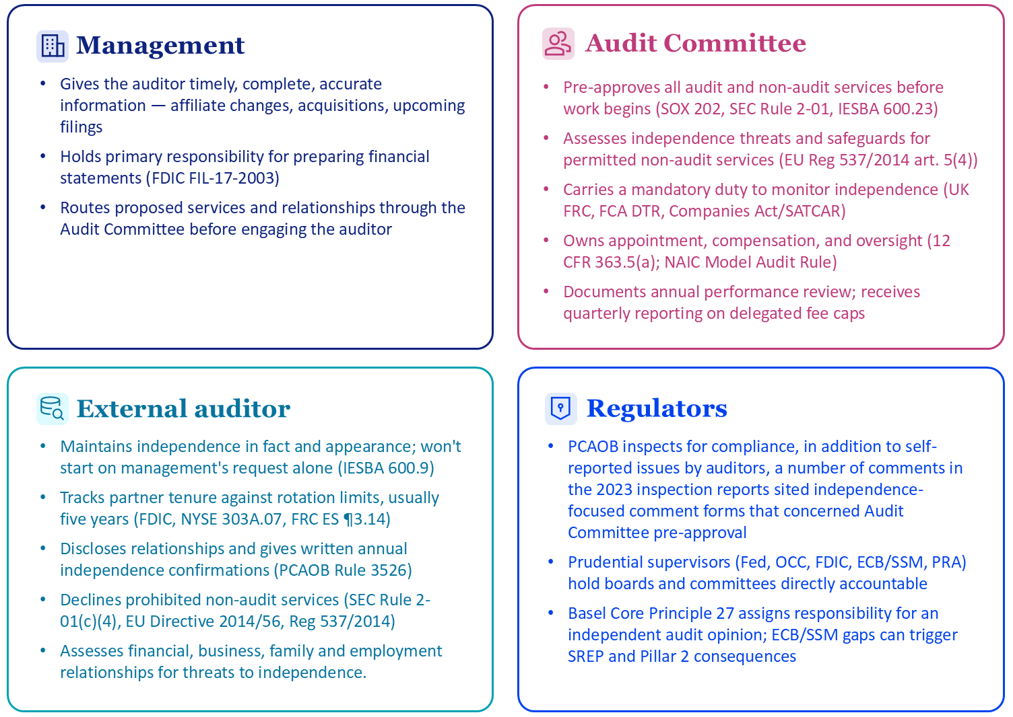
Every major independence framework distributes responsibility across four parties: management, the Audit Committee, the external auditor, and supports the needs of the regulators who oversee all three. Effective programs make each party's responsibilities explicit, and build accountability, communication, and documentation around each of them. Some of the respective responsibilities and roles are summarized below.
3. Common Themes Across Global Regulatory Frameworks
Independence rules differ in citation and drafting style from one jurisdiction to the next, but the underlying architecture is remarkably consistent: every framework surveyed place binding, codified independence-monitoring obligations on the audit committee (or equivalent governance body) in addition to the auditor. Five common principles recur across nearly every framework surveyed:
There are differences by jurisdiction that must be considered in an overall audit independence governance program.
The table below summarizes examples of how several major frameworks express that shared-responsibility principle.
|
Jurisdiction / Regulator |
How Shared Responsibility Is Expressed |
Source |
|
United States – SEC |
“Compliance with auditor independence rules is a shared responsibility among companies, their audit committees, and their auditors.” |
SEC OCA Statement, June 8, 2022; Rule 2-01 of Regulation S-X |
|
United States – PCAOB |
“Independence is a shared responsibility between the entity under audit, its audit committee, and its auditor.” In 2023, roughly one-third of independence-focused comment forms related to Audit Committee pre-approval. |
PCAOB September 2024 Inspection Observations Spotlight |
|
Global – IESBA |
A firm shall not provide a non-assurance service unless those charged with governance concurred with the provision of that service |
IESBA International Code of Ethics, Section R600.23 |
|
European Union |
Both the auditor and the Audit Committee carry binding, codified independence-monitoring obligations under directly applicable EU law. |
EU Audit Regulation 537/2014, Articles 5 and 6 |
|
United Kingdom |
The Audit Committee of a Public Interest Entity has a mandatory, enforceable duty to monitor auditor independence, a joint obligation with the auditor. |
FRC Ethical Standard 2024; FRC Audit Committee Minimum Standard 2023; UK Corporate Governance Code 2024; FCA DTR 7.1.3R; Companies Act 2006 (SATCAR) |
|
Australia |
Management has an express duty to communicate independence-relevant matters to the Audit Committee, which must actively monitor and assess independence rather than passively receive disclosures. |
Corporations Act 2001 (s307C, s324CA); APES 110; ASA 260 |
|
Singapore |
The auditor must disclose to the Audit Committee once non-audit fees threaten independence; the committee must review independence annually. |
ACRA Code of Professional Conduct & Ethics; Code of Corporate Governance 2018 |
|
Japan |
The Companies Act statutorily separates the auditor-oversight body from management and gives it consent rights over the external auditor's pay and appointment; the FIEA requires the auditor to actively coordinate with that body. |
Companies Act Art. 331(3), 344, 399; FIEA Art. 193-2(2); FSA; CPA Act; JICPA Ethics Code |
|
US Banking – FDIC / OCC / Federal Reserve |
External auditor must meet AICPA, SEC, and PCAOB independence standards; the Audit Committee must pre-approve non-audit services and document its review. |
12 CFR Part 363, §363.3(f), §363.5; FIL-17-2003; SR 03-5; SR 13-1 / CA 13-1 §4 |
|
US Insurance – NAIC |
A SOX-style three-way split: the Audit Committee owns appointment, oversight, and pre-approval of services; the auditor faces explicit prohibited-service and rotation rules. |
NAIC Annual Financial Reporting Model Regulation (Model #205), “Model Audit Rule” |
|
Global – Basel Committee (Banking) |
The Audit Committee must monitor auditor independence, assess audit effectiveness, and require the auditor to report all relevant matters; the board and management are responsible for ensuring the opinion is genuinely independent. |
BCBS “External Audits of Banks” (2014), Principles 2–5; Core Principle 27 |
4. Building an Effective Operating Model
Meeting these obligations consistently across every legal entity, affiliate, engagement, and jurisdiction requires an operating model, not just a policy document. The core components are governance, policy, workflow, legal-entity and affiliate data management, engagement inventory, approvals, monitoring, reporting, and technology enablement. This operating model must leverage the core components to align the responsibilities and support the governance by the key parties – management, the audit committee, the external auditors, and supporting the needs of regulators.
Governance and Policy
Workflow: The Engagement Letter Lifecycle
A well-designed independence operating model treats each engagement letter as the trigger for a defined, auditable workflow rather than an ad hoc email exchange:
Legal Entity and Affiliate Data Management
For financial institutions and investment company complexes, accurate legal-entity and family-tree data is what makes the independence analysis possible in the first place. The SEC's 2020 amendments to Rule 2-01(f) introduced a dual materiality threshold: a sister entity is treated as an affiliate of the audit client only if both the sister entity and the entity under audit are each material to their controlling entity. If either is immaterial, the entity falls outside the affiliate definition, but that does not end the analysis. The SEC has been explicit that relationships with entities excluded under the amended definition must still be evaluated, individually and in the aggregate, against the general independence standard in Rule 2-01(b). In practice, this means the Audit Committee needs a mechanism to run two analyses for every entity potentially within the Investment Company Complex: first, whether the dual materiality threshold makes it an affiliate (triggering specific prohibited-service rules), and second, regardless of the answer to the first question, whether services or relationships with that entity impair independence under the general standard. For an active fund complex or alternative asset manager, the population of affiliates changes with every new fund closing, portfolio company acquisition, exit, co-investment, and new credit position, so this needs to be a continuously maintained data set, not a point-in-time exercise.
Engagement Inventory, Monitoring, and Approvals
Technology Enablement
Manual, spreadsheet-based independence review does not scale to the volume of engagements, entities, and jurisdictions that a large financial institution or fund complex must track, and it leaves an audit trail that is difficult to defend. Organizations are increasingly automating the independence workflow described above from engagement letter intake, global independence review, letter review, management reporting, and ultimately Audit Committee reporting to create a documented, real-time, and consistent process. The benefits reported from this kind of automation cluster around three themes:
5. Reporting to Management and the Audit Committee
An effective independence program is only as valuable as the transparency it provides to the people accountable for oversight. Recurring reporting to management and the Audit Committee should cover:
Reported consistently, this reporting package gives management and the Audit Committee what SEC, PCAOB, and prudential guidance all describe as the necessary basis for active, ongoing monitoring.
Conclusion
Audit relationships are built on trust, sound policy and process, and transparency. Auditor independence cannot be delegated entirely to the auditor, and it cannot be managed reliably through informal, spreadsheet-based processes once an organization operates across multiple legal entities, service providers, and jurisdictions. Every major regulatory framework from the SEC and PCAOB to the IESBA, the EU, the UK, and prudential banking and insurance supervisors worldwide treats independence as a shared responsibility of management, the Audit Committee, and the auditor, and increasingly hold the Audit Committee accountable for active, documented monitoring rather than passive receipt of disclosures.
Organizations that invest in strong governance and a robust operating model clear policy, a defined engagement-letter workflow, accurate legal-entity and affiliate data, systematic monitoring, and real-time reporting are better positioned to demonstrate compliance, respond effectively to regulators and inspections, reduce operational and reputational risk, and give management and the Audit Committee the transparent, timely information they need to exercise real oversight. Technology that automates and documents this process does not replace the judgment of management, the Audit Committee, or the auditor; it gives all three the consistent, auditable foundation that shared responsibility requires.






 1401 6th Ave South, Clear Lake, IA 50428
 1-641-355-1000